

 실무교육 > 실무교육안내 > 2015년 실무교육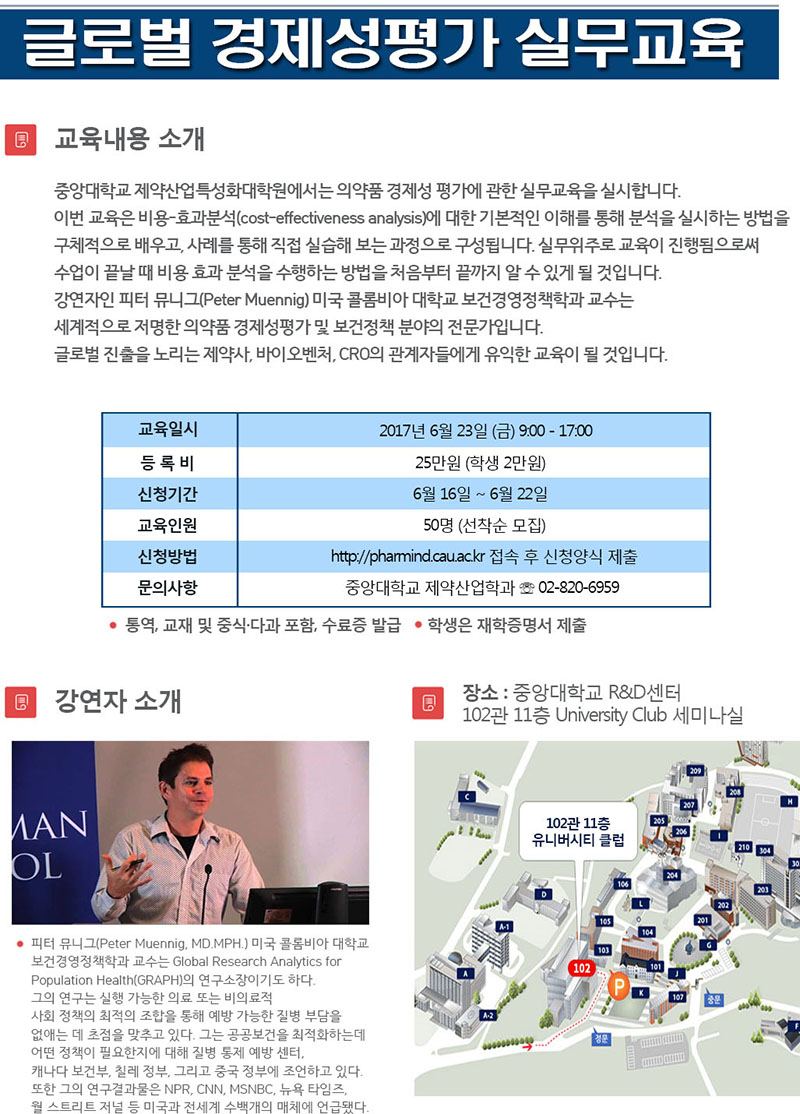
 Peter Muennig
MPH(1998, Columbia University), MD(1994, University of California at San Diego)
Peter Muennig is a Professor in the Department of Health Policy and Management at Columbia University and the Director of Global Research Analytics for Population Health (GRAPH).
His research focuses on eliminating the preventable burden of disease through the optimal mix of actionable medical and non-medical social policies. He does so primary via randomized controlled trials of social policies coupled with cost-effectiveness analysis.
His work includes policies aimed toward reducing class sizes, universal pre-kindergarten, welfare reform, the Earned Income Tax Credit, Vision Zero, capping freeways for greenspace as some examples.
He has advised the Centers for Disease Control and Prevention, Health Canada, the Chilean government, and the Chinese government regarding which policies might be needed to optimize population health. He has published over 115 peer-reviewed articles in the scientific literature, and has written 4books. His work has appeared on NPR, CNN, MSNBC, New York Times, the Wall Street Journal, and Slate as well as hundreds of outlets in the US and worldwide.
| 일자 | 시간 | 강의주제 |
|---|---|---|
| 6/23(금) | 09:00-10:30 | section 1 : Why cost-effectiveness analysis? 왜 비용 효과 분석을 하는가? In the first segment, we will review everything that you have learned about economic analysis. We will discuss the differences between cost-effectiveness analysis and cost-benefit analysis. We will also review how the different types of economic analyses are used in different countries. 첫번째 부분에서는 경제성 분석에 대해 배웠던 모든 것을 검토한다. 비용 효과 분석과 비용 편익 분석의 차이에 대해 논의하고, 다양한 국가에서 다양한 형식의 경제 분석이 어떻게 사용되는지도 검토한다. |
| 10:30-10:50 | Break | |
| 10:50-12:00 | section 2 : How to put a cost-effectiveness research project together 비용 효과 연구 프로젝트의 중요한요소들을 이용하여 경제성평가를 실시하는 방법 In this segment, we will discuss how to plan a research project, where to find data, how to organize your work, and the importance of anticipating where you will publish your work. 연구 프로젝트를 어떻게 계획할지, 데이터를 어디서 찾을지, 연구를 어떻게 구성할지와 결과물을 어디에 게재할지 예측하는 것의 중요성에 대해 논의한다. |
|
| 12:00-13:00 | Lunch | |
| 13:00-14:30 | section 3 : Calculating costs, life expectancy, and quality-adjusted life years. 비용, 기대 수명, 질보정 기대수명(QALY)의 계산방법 In this section, we will discuss how to all of the core parts of a cost-effectiveness analysis are calculated, and how they all come together. 비용 효과 분석의 모든 핵심 부분들 (비용, 기대수명 계산, 질보정 기대수명 등)이 어떻게 도출되고 어떻게 이러한 값들이 결합되어 사용되는지에 대해 논의한다. |
|
| 14:30-14:50 | Break | |
| 14:00-17:00 | section 4 : Markov models, a worked example. 마르코프 모델 적용해보기 In this segment, we will actually run through a worked example in class, building a Markov model piece by piece. By the end of the class, you should have an idea how to conduct a cost-effectiveness analysis from start to finish! 수업시간에 상의한 마르코프 모델의 예를 이용하여 경제성평가를 차근차근 실습해본다. 수업이 끝날 때 비용 효과 분석을 수행하는 방법을 처음부터 끝까지 알수 있게 된다. |


